
Smart Locks vs. Traditional Locks: Why Traditional Locks Alone Are No Longer Enough
When you secure your home, you might believe that any lock serves the purpose. However, the truth is that traditional locks carry serious weaknesses that make them insufficient on their own in today’s world. Let us first review these vulnerabilities, and then we will compare them with smart lock solutions.
Main Weaknesses of Traditional Locks
First, the most dangerous problem lies in the ease of key duplication. In just a few minutes, anyone can access your key and replicate it without your knowledge. Consequently, this makes your home vulnerable to break‑ins even without breaking the lock.
Second, most traditional locks – especially the cheap ones – can be broken using simple tools such as screwdrivers or wire cutters. This means that a skilled thief can disable the lock within seconds.
Third, traditional locks offer no flexibility in control. You cannot know who entered your home or when they did. Moreover, there is no way to grant someone temporary access and then revoke it without replacing the entire lock.
Fourth, key management poses a major problem. The larger your family, the higher the chance of losing a key or forgetting it inside the house. In case of key loss, the only solution is to change the entire lock – an expensive and troublesome procedure.
Fifth, traditional locks do not issue any alarm when someone tampers with them. As a result, burglars can try to open the lock for hours without you sensing any danger.
Why Smart Locks Offer the Solution
In contrast to these drawbacks, smart locks provide multi‑layered security. They rely on digital encryption that is difficult to breach. Furthermore, they send you instant notifications for every unauthorised entry attempt. In addition, you can control your lock from your phone anywhere in the world, and you can share temporary passcodes for guests that expire automatically.
Smart locks also record a precise log of every entry and exit, including the time and date. Instead of changing the lock when you lose a key, you can simply delete any user’s access permission.
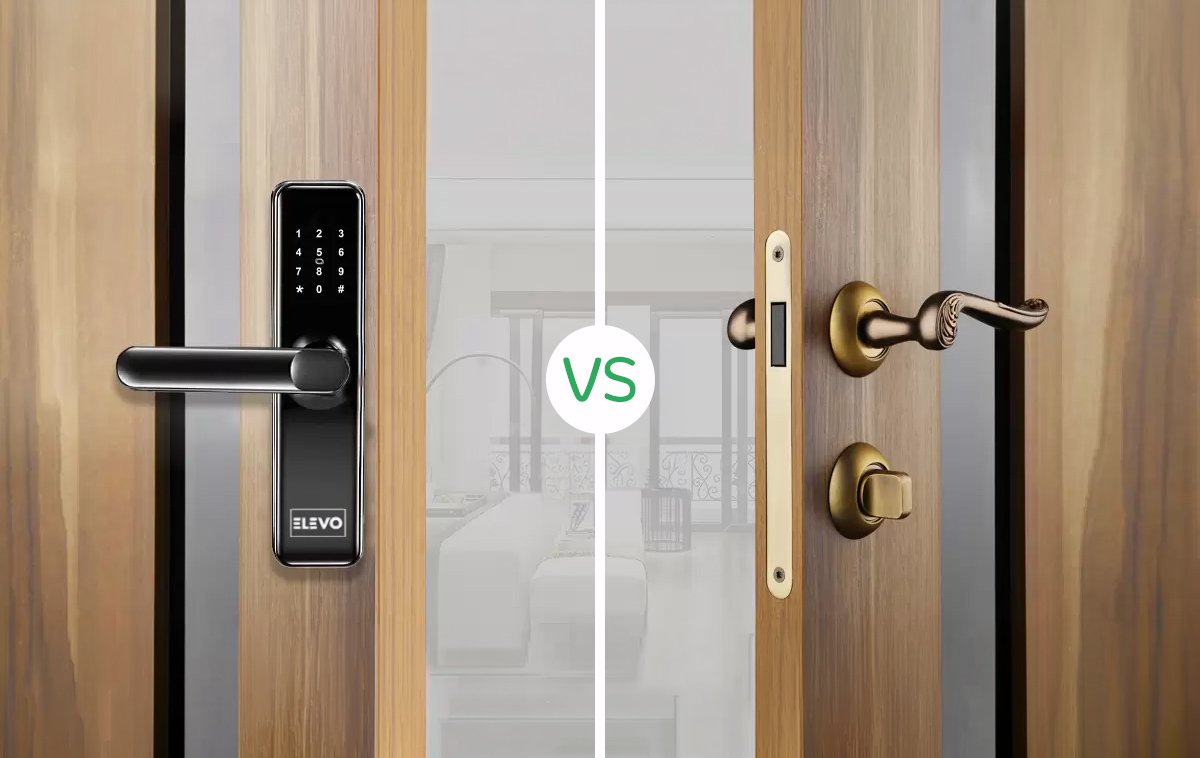
Smart Locks vs. Traditional Locks: Which One Better Protects Your Home?
When discussing home security, choosing the right locking system remains one of the most important decisions for every family. While traditional locks have served humanity for centuries, smart locks have recently emerged as an advanced technical solution. But which one provides better protection for your belongings?
Traditional Locks: The Simple and Familiar Solution
Traditional locks enjoy simplicity and ease of use – they require no technical knowledge and suit all ages. Additionally, they feature low cost and wide availability in the market. On the other hand, these locks operate without electricity or batteries, which ensures they continue working even during power outages.
However, traditional locks carry fundamental disadvantages. A metal key can be copied easily, and some cheap locks can be broken. Most importantly, they lack any flexibility; you cannot control them remotely, nor can you share temporary access permissions with guests.
Smart Locks: A Qualitative Leap in Security
In contrast, smart locks offer advanced security thanks to multiple technologies such as fingerprint scanning, secret PIN codes, and smartphone applications. Moreover, these locks provide instant notifications for every entry attempt and record accurate logs of all entry and exit operations with time and date.
Smart locks also feature outstanding flexibility – you can easily share temporary access permissions with workers or guests. Furthermore, you can integrate them with smart home systems, including cameras and alarm devices.
Weaknesses of Smart Locks
Nevertheless, smart locks are not without disadvantages. They cost more than traditional locks, and they rely on batteries that require regular monitoring. Additionally, limited electronic risks exist when the lock lacks strong encryption.
Which One Should You Choose for Your Home?
To answer this question, the choice depends on your specific needs. If you seek a simple and economical solution, or you live in a low‑risk area, traditional locks may suffice. However, if you travel frequently, have children who need monitoring, or desire peace of mind through real‑time control, smart locks are the best option.
As a compromise, you can combine both systems: install a smart lock as your main entry point together with a traditional internal lock – this adds an extra layer of security.
In conclusion, traditional locks have served humanity for decades, but they are no longer enough on their own to meet modern security challenges. While the final decision remains linked to your budget and needs, the future undoubtedly belongs to smart locks that give you psychological comfort and complete control over your home wherever you are.
”Traditional locks are no longer sufficient on their own to face the challenges of modern security. Their weaknesses are numerous: easy key duplication, vulnerability to breakage, lack of flexibility, difficult key management, and no alarms. If you seek real protection for your home and family, investing in a smart lock from a trusted brand is the safest decision – even if it costs more initially. You can always keep a traditional lock as an additional layer, but do not rely on it as your sole
Summary